Komori Sprint: Roller Measurements Before Replacement
Documenting Komori Sprint Roller Measurements Accurately
Before ordering replacement rollers for an offset press, taking and verifying accurate Komori Sprint roller measurements is an essential preparatory step. Press units rely on precise mechanical interaction across both inking and dampening systems, making thorough documentation necessary before recoating or new core manufacturing.
This guide outlines the critical dimension fields, position designations, and verification steps needed by press operators, maintenance engineers, and roller buyers to prepare accurate specifications without guesswork.
Key Takeaways for Replacement Planning
- Confirm the full press nameplate data and specific model variant before ordering.
- Record both rubber face length and total overall shaft length alongside outer diameter.
- Map every roller to its exact assigned position code across the inking or dampening unit.
- Verify the installed dampening hardware arrangement to match water roller configurations.
- Audit quantities according to the exact number of active printing units on the press.
Understanding Core Roller Dimensional Terms
Roller dimensioning relies on standard mechanical parameters to communicate geometry clearly between the workshop floor and the roller manufacturer.
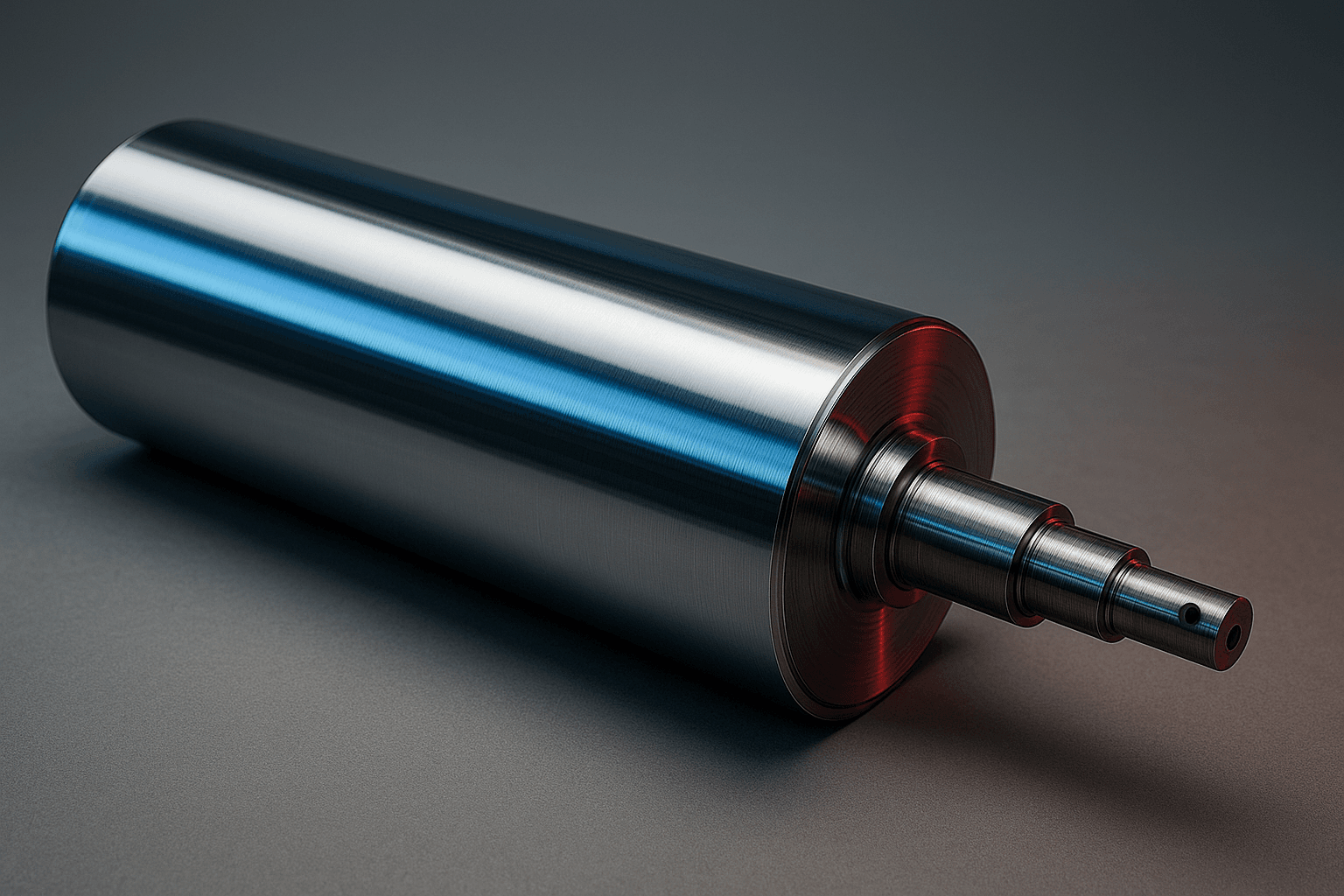
- Diameter: The outside measurement of the finished rubber covering across the roller body.
- Rubber Length: The active face length of the elastomeric covering, excluding core journals.
- Total Length: The complete end-to-end overall length of the core, including journals and shaft ends.
- Position Code: The designated alphanumeric identifier marking a roller's exact functional location within the unit.
Technical Details and Positional Mapping
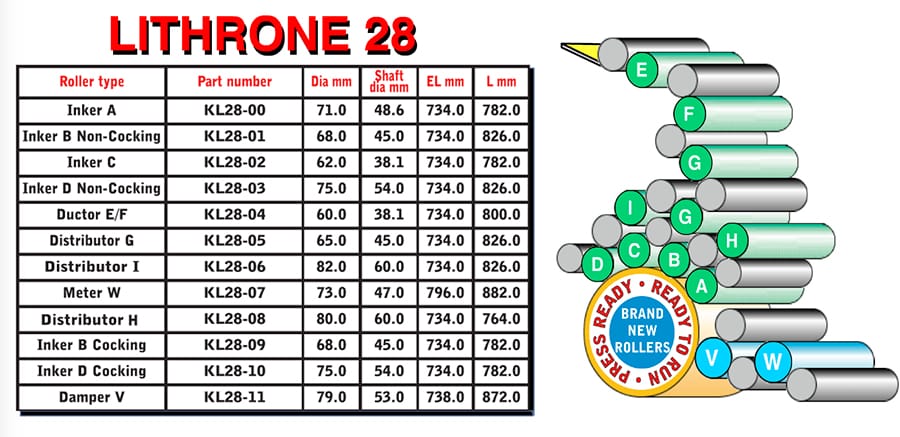
In offset configurations such as the Komori Sprint series, rollers are categorized functionally into inking units and dampening units. Each roller position serves a distinct mechanical role in fluid distribution and transfer.
| Unit Section | Position Designations | Measurement Fields Required |
|---|---|---|
| Inking Unit Forms | A Form, B Form, C Form, D Form | Diameter, Rubber Length, Total Length |
| Inking Unit Feed & Distribution | E Ductor, F Distributor, G Distributor, H Distributor | Diameter, Rubber Length, Total Length |
| Dampening Unit | V Water Form, W Water Meter | Diameter, Rubber Length, Total Length |
In addition to physical geometry, specifications require tracking the compound material type—such as nitrile rubber (NBR), polyurethane (PU), or silicone—matched to the press chemistry and required Shore A hardness range.
Selection Factors Before Placing an Order
Ordering replacement rollers requires evaluating several operational and mechanical criteria to guarantee correct fit and reliable press performance:
- Press Model and Nameplate Details: Differentiate among machine variants such as S-26, S-226, or S-226P to match frame and hardware configurations.
- Installed Dampening Hardware: Account for the specific dampening system arrangement, particularly for water form and water meter rollers.
- Chemical Compatibility: Select compound formulations (such as NBR, PU, or silicone) suited to your fountain solution, inks, and regular washup solvents.
- Printing Unit Count: Multiply position quantities correctly across single-color or multi-unit press lines.
- Surface Finish Requirements: Specify concentric grinding standards to ensure uniform fluid laydown and prevent uneven nip contact.
Step-by-Step Procedure for Recording Komori Sprint Roller Measurements
- Locate and record the machine nameplate data, confirming the exact model variant and bill of materials.
- Map each roller scheduled for replacement to its standardized position code within the inking or dampening unit.
- Measure and record the finished outer rubber diameter across the cylindrical body.
- Measure the active rubber face length along the body, excluding exposed metal cores and journals.
- Measure the total overall length from journal tip to journal tip.
- Document the existing dampening hardware type to ensure water roller compatibility.
- Confirm the chemical wash and ink types in use to determine the appropriate elastomer compound and Shore A rating.
- Compile all recorded measurements and unit quantities into a consolidated verification sheet before submitting for quotation or production.
Troubleshooting Common Measurement and Fit Discrepancies
| Symptom | Likely Root Cause | Corrective Action |
|---|---|---|
| Mismatch in roller diameter compared to press manual references | Compound swelling from aggressive chemical washes or wear-induced diameter reduction | Check press nameplate against parts list; verify whether swelling or shrinkage has shifted the baseline profile. |
| Dampening roller journals fail to seat in unit mountings | Unverified dampening unit arrangement or incorrect total core length measurement | Verify the specific installed dampening hardware configuration on the press frame before manufacturing. |
| Inconsistent ink stripe or uneven nip width across the roller face | Uneven rubber wear, lack of concentric grinding, or unadjusted post-installation nip settings | Re-check nip settings following initial installation and thermal break-in cycles. |
| Premature surface glazing or physical flat spotting | Incompatible wash solvents, chemical glazing buildup, or leaving idle rollers in static contact | Use wash chemistry compatible with compound; rotate idle rollers regularly to prevent permanent set marks. |
Frequently Asked Questions
Why must both rubber face length and total length be documented?
Rubber length ensures full transfer coverage over the plate and cylinder surfaces, whereas total length ensures the core journals seat correctly inside the press bearings and oscillating mechanisms.
What information from the press nameplate is critical when ordering rollers?
The exact model designation and series identifier should always be captured. Configurations can vary across series variants, particularly regarding dampening roller mountings and journal designs.
When should roller nip settings be re-checked after replacing rollers?
Nip settings should be verified immediately upon installation and re-checked following the first heat cycle to accommodate initial thermal expansion and dynamic running conditions.
Approved Reference Documentation
The positional definitions, dimensioning fields, and maintenance protocols referenced in this guide are derived from the following approved technical source:
- Cooper Rollers — Komori Sprint Product Documentation and Technical Specification Sheet (Source UID: 6cbd24ed-50dd-42ec-be20-cf1d50a23ae7)
Related Reading and Technical Resources
Explore further guidance on maintenance protocols, compound selection, and offset press roller care:
- Best Practices for Setting Offset Inking and Dampening Nips
- Selecting Elastomer Compounds: Balancing NBR, PU, and Silicone for Press Chemistries
- Preventing Roller Glazing and Hardness Drift in High-Volume Offset Printing