WEB MANUGRAPH STARLINE 30: Roller Covering Hardness Guide
WEB MANUGRAPH STARLINE 30: Roller Covering Hardness and Selection
Selecting appropriate covering hardness for WEB MANUGRAPH STARLINE 30 rollers is essential for stabilizing ink laydown, sustaining water film uniformity, and preventing premature surface wear across demanding press runs. While press operators frequently seek exact mechanical figures for roller maintenance, published engineering documentation emphasizes matching covering properties directly to functional positions rather than relying on arbitrary, generalized figures.
For model-specific details, refer to the WEB MANUGRAPH STARLINE 30 roller specifications. This guide provides an evidence-grounded review of how roller coverings, surface finishes, and compound formulations function across web offset units. By understanding the distinction between recorded engineering attributes and undocumented assumptions, maintenance personnel and plant engineers can make sound operational choices that preserve print consistency.
Key Takeaways
- Application Matching: Covering hardness and surface finishes are engineered to correspond directly to specific roller roles within inking and dampening assemblies.
- Compound Resilience: Formulations are specifically developed to resist the adverse effects of wash solvents, dimensional swelling, and mechanical glazing.
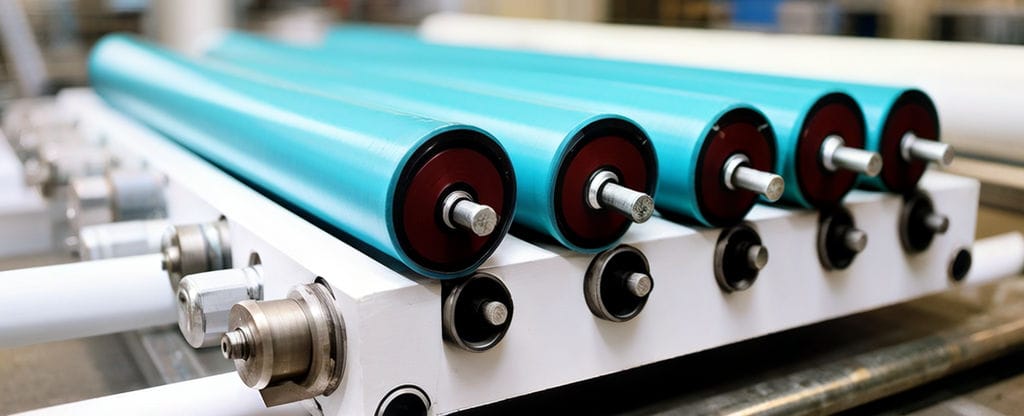
- Visual Error Prevention: Where color coding is specified, it can help identify roller positions during changeovers and reduce the risk of installing the wrong roller.
- Traceability and Quality Control: Verified manufacturing relies on batch-level compound traceability, balance precision, and ground geometry rather than unverified generic ratings.
- Environmental Variables: Formulation recommendations depend on press variables including paper stock, ink systems, and plant climate conditions.
Defining Covering Hardness and Compound Specifications
In industrial roll manufacturing, covering hardness denotes the elastomeric resistance of a roller sleeve or coating to mechanical indentation under contact load. In printing environments, roller coverings are typically composed of vulcanized rubber compounds or cast polyurethane materials formulated to flex within defined nip widths.
In Cooper Rollers’ STARLINE 30 product information, hardness is treated as a tailored functional characteristic rather than an isolated generic property. Instead of publishing blanket numeric Shore scales, specifications focus on surface finish and compound structure matched to the mechanical demands of each unit position.
Editorial verification note:
- Specific numeric Shore durometer ratings are omitted from official source documentation, which instead defines hardness qualitatively as matched to application.
Technical Characteristics and Roller Positions
A standard web offset press configuration divides fluid delivery into discrete mechanical groups. The WEB MANUGRAPH STARLINE 30 press layout incorporates specialized rollers across both inking and dampening sections, each exhibiting distinct covering performance requirements.
| Unit Group | Designated Roller Types | Primary Mechanical Function | Covering Focus |
|---|---|---|---|
| Inking Unit | Ink Forme Rollers, Ink Transfer Rollers, Rider Rollers | Transfer and split ink films from distribution trains onto the plate surface | Precision-ground geometry, solvent resistance, uniform laydown |
| Dampening Unit | Damp Forme Rollers | Continuous metered application of fountain solution | Fount resistance, stable water film maintenance, swelling resistance |
| Auxiliary / Specialized | Rider / Impression (Polyurethane), Ductor, Numbering, Varnishing | Intermediate metering, surface rider contact, or specialized finishing passes | Structural stability, resistance to mechanical glazing, custom bareback builds |
Beyond hardness, precision-ground geometry ensures rotational balance at web production speeds. Compounds are formulated to withstand fountain solutions and cleaning chemistry without undergoing rapid dimensional distortion.
Factors Governing Covering Selection
Selecting an elastomeric covering requires evaluating how dynamic press variables interact with compound chemistry. Rather than choosing a single standardized material, engineers consider multiple operating factors:
- Press Position: Dampening rollers must maintain continuous hydrodynamics, whereas inking positions require stable film transfer under frictional contact.
- Ink and Solvent Chemistry: Formulations must resist swelling, softening, or hardening caused by inks, washes, and aggressive pressroom solvents.
- Substrate Characteristics: The choice of printing stock influences surface pressure and mechanical resistance requirements.
- Ambient Climate: Temperature fluctuations and relative humidity inside the press hall directly affect compound elasticity and chemical uptake.
- Dimensional Accuracy: Roller cores must receive coverings manufactured to OEM-equivalent tolerances to preserve parallel contact and prevent localized overheating.
Process for Verifying and Installing Covering Specifications
To ensure reliable performance across long production runs, maintenance teams should follow a systematic verification and replacement process:
- Audit Machine Positions: Catalog whether the roller will serve as an ink forme, ink transfer, rider, or damp forme roller within the unit.
- Assess Operating Parameters: Document the active ink systems, fount solutions, paper grades, and pressroom ambient conditions.
- Confirm Compound Match: Consult technical guidance to select rubber or polyurethane formulations tuned for chemical resistance and surface application.
- Inspect Transit Packaging: Ensure coverings arrive in protective packaging to prevent surface indentations or flat spots before installation.
- Verify Color-Coding: Match the roller's visual identification bands against press layout schematics to eliminate positioning mistakes.
- Verify Dimensional Fit: Confirm that roller diameter, rubber face length, and overall length align with machine specifications before locking journals into bearings.
Troubleshooting Roller Surface and Covering Defects
Elastomer degradation typically produces measurable print quality defects and physical changes on the roller surface. Addressing these early prevents unplanned downtime.
| Observed Symptom | Suspected Physical Cause | Evaluation Steps | Corrective Action |
|---|---|---|---|
| Surface Glazing | Accumulation of dried ink resins, fountain chemistry residues, or friction burnishing | Inspect covering texture under light for polished, glass-like patches | De-glaze with approved wash chemicals or recondition surface finish |
| Covering Swelling or Softening | Chemical incompatibility between covering compound and press solvents or wash solutions | Check for diameter variations or irregular nip profiles across the roller face | Switch to solvent-resistant compounds tuned for specific ink and fount chemistry |
| Uneven Ink Laydown or Streaking | Loss of dimensional accuracy, balance error, or improper positioning | Verify roller color coding, check journal seating, and evaluate rotational concentricity | Realign roller seating and ensure precision-ground OEM-equivalent units are installed |
| Unstable Water Film | Surface degradation on damp forme covering or dynamic pressure mismatch | Examine dampening unit surface finish for contamination or localized wear | Clean, readjust contact pressure, or replace with application-matched dampening coverings |
Frequently Asked Questions
What does application-matched covering hardness mean for STARLINE presses?
It means the elastomer's formulation, flexibility, and finish are balanced specifically for the fluid and mechanical loads of that position—such as ink transfer or dampening film metering—rather than using a generic material across all positions.
Why do manufacturers avoid publishing universal numeric Shore hardness values?
Publishing isolated numeric ratings can lead press operators to overlook critical material characteristics, such as compound swelling resistance, dynamic heat buildup, elasticity under load, and solvent compatibility, which are critical to long-term performance.
How does color-coding assist during press maintenance?
Color coding provides visual differentiation for each roller type, ensuring operators place ink forme, transfer, and dampening rollers in their correct press locations without confusion.
Are specialized coverings available for custom finishing or numbering units?
Yes. Beyond standard inking and dampening sets, specialized bareback, varnishing, and numbering configurations can be produced to match specific press configurations.
Sources and Technical Evidence
The technical claims in this guide are derived from first-party engineering and specification documentation maintained by Cooper Rollers for web offset press components:
- Source UID 763ff685-73ad-4d65-a72d-55a2e07dffcd: WEB MANUGRAPH — STARLINE 30 Rollers, Cooper Rollers Product Catalog. Corroborates roller positions (ink forme, ink transfer, rider, damp forme), compound resistance to solvents, swelling, and glazing, precision grinding standards, batch-level QC traceability, and application-matched surface hardness.
Related Reading and Technical Resources
Explore additional technical guides and maintenance principles for web press roller care:
- Web Offset Nip Adjustment and Alignment Protocols
- Preventing Chemical Swelling and Glaze in High-Speed Press Chemistry
- Polyurethane versus Rubber Formulations for Commercial Rider Rollers
- Best Practices for Storing and Protecting Precision-Ground Roller Sleeves