ADAST DOMINANT 713: Core and Shaft Details Checklist
Introduction to Core and Shaft Verification
Maintaining precise mechanical records for offset press rollers is essential for dependable operation and smooth re-covering cycles. When documenting ADAST DOMINANT 713 core and shaft details, press operators and maintenance teams must account for each position in the inking and dampening systems without relying on guesswork. Verifying the underlying core and spindle structure before recovering or replacement ensures proper fit, reliable bearing engagement, and consistent press performance.
Key Takeaways
- Accurate core and journal documentation prevents misfits and installation delays during roller replacement.
- The inking and dampening units comprise multiple distinct roller positions, including form rollers, distributors with varying spindle designs, and ductor rollers.
- Certain distributor positions require differentiation between standard spindle and short spindle configurations.
- Physical verification must capture key parameters such as roller diameter, rubber length, and total overall length without relying on undocumented assumptions.
- Inspecting cores for physical wear, runout, and journal integrity before recoating protects long-term print consistency.
Understanding Roller Cores, Shafts, and Spindles
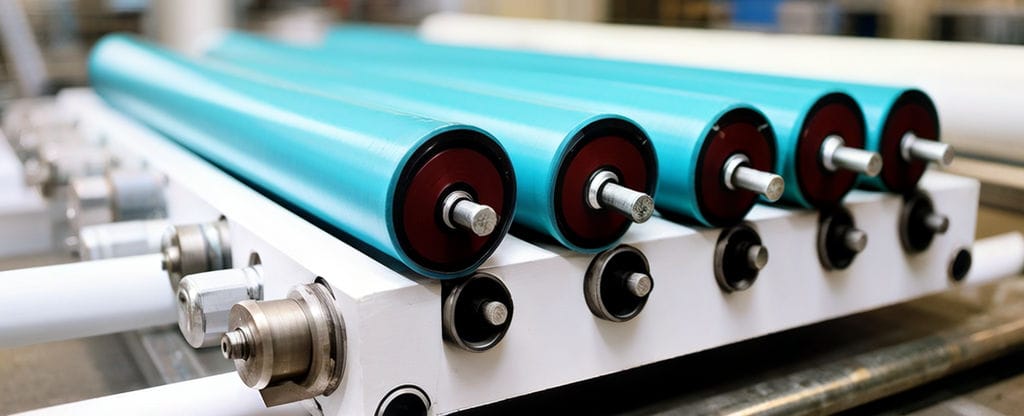
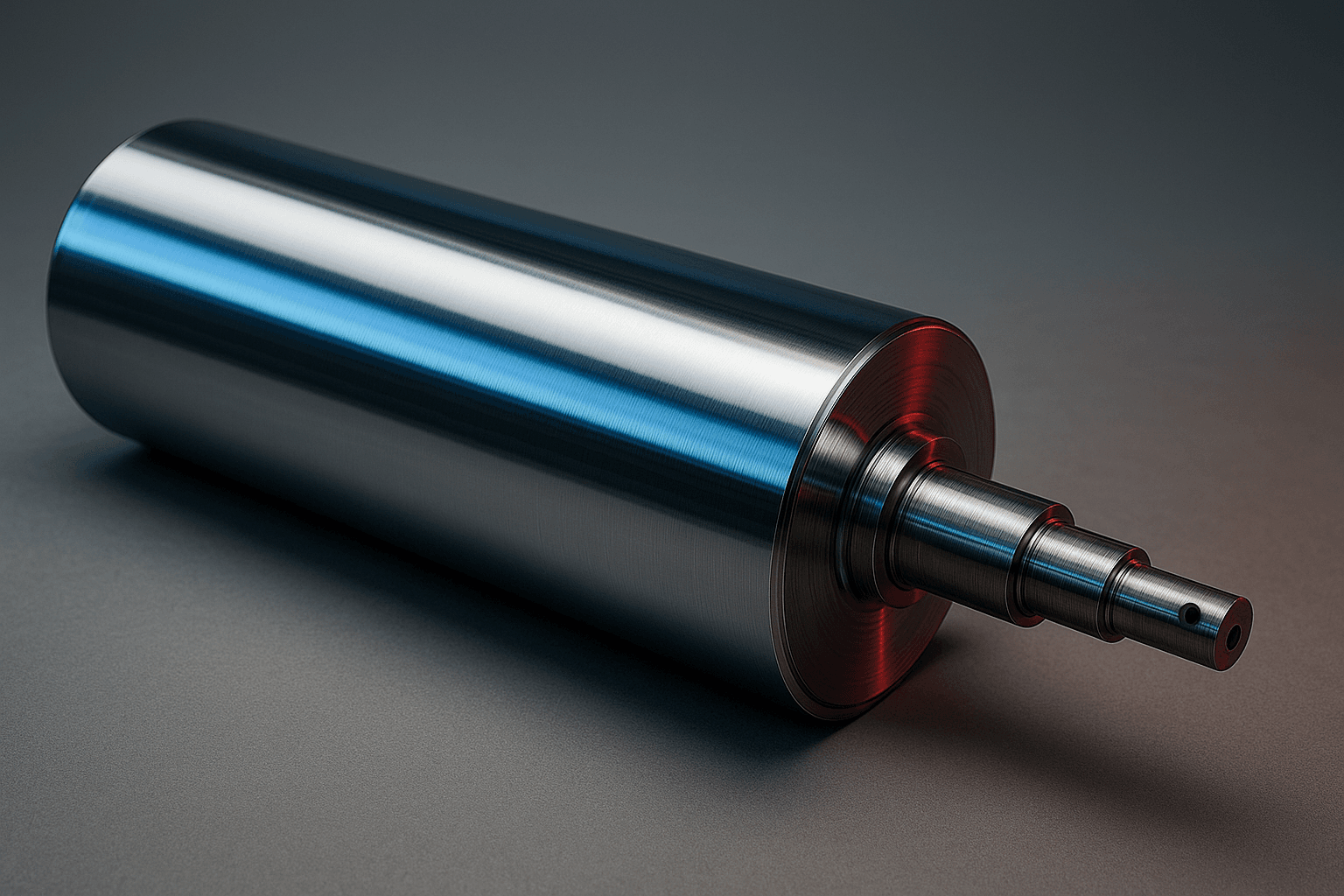
In offset printing equipment, the roller core serves as the rigid tubular or solid metallic foundation upon which the elastomeric covering is bonded. Shafts, spindles, and bearing journals extend from the core ends, providing mounting surfaces for bearings, bushings, and press drive mechanisms.
Within the press roller train, different operational positions impose distinct mechanical demands on the core and shaft assembly:
- Roller Core: The structural body that supports the elastomeric coating across the print width.
- Bearing Journal: The precision-machined end section that locates into machine bearings or eccentric housings.
- Spindle Configuration: The shaft profile and length designed to integrate with specific frame pockets or oscillating mechanisms, including short spindle variations.
- Total Length vs. Rubber Length: The critical distinction between the active face covered by elastomer and the tip-to-tip span across both shaft ends.
ADAST DOMINANT 713 Core and Shaft Details by Position
Press configurations require specific attention to roller position names, functional duties, and shaft geometries. Recording all parameters systematically prevents cross-matching errors between adjacent roller stations.
| Unit Group | Roller Designation | Spindle or Core Variation | Primary Dimensional Fields |
|---|---|---|---|
| Inking Unit | Ink Form Roller | Standard mounting journals | Roller diameter, rubber length, total length |
| Inking Unit | Ink Distributor | Short spindle configuration | Roller diameter, rubber length, total length |
| Inking Unit | Ink Distributor | Standard spindle configuration | Roller diameter, rubber length, total length |
| Inking Unit | Ink Ductor | Drive and pivot journal arrangement | Roller diameter, rubber length, total length |
| Dampening Unit | Water Form Roller | Precision dampening journals | Roller diameter, rubber length, total length |
| Dampening Unit | Water Ductor Roller | Oscillating and feed journals | Roller diameter, rubber length, total length |
Rider rollers can also be integrated into the roller train, requiring their own shaft verification records to ensure complete train alignment.
Core and Shaft Evaluation Criteria
When assessing cores for re-covering or sourcing replacement shafts, maintenance personnel must evaluate multiple mechanical and operational factors:
- Journal Condition: Presence of scoring, fretting corrosion, or deformation on bearing landing surfaces.
- Spindle Variation: Identification of whether a position requires a standard spindle or a short spindle geometry.
- Dimensional Integrity: Verification that the core body has not bowed, warped, or experienced irregular surface loss.
- Dynamic Balance and Concentricity: Absence of runout across the core face and shaft extensions.
- Elastomer Compatibility: Ensuring the core surface is sound for stripping, sandblasting, and re-bonding of hybrid or conventional rubber formulations.
Step-by-Step Core and Shaft Inspection Checklist
- Identify Position and Designation: Match the roller to its press unit position, verifying whether it is an ink form, ink distributor, ink ductor, water form, or water ductor.
- Check Spindle Type: Note specific mechanical differences, particularly distinguishing short spindle distributor rollers from standard distributor rollers.
- Measure Critical Envelope Fields: Record the finished roller diameter, active rubber length, and total overall length from shaft end to shaft end.
- Inspect Mechanical Surfaces: Examine keyways, threads, snap ring grooves, and bearing seat journals for burrs, wear, or dimensional degradation.
- Document Item and Serial Identifiers: Log item codes, position quantities, and internal tracking tags on your press maintenance record sheet.
- Confirm Fit Prior to Covering: Verify that bare cores spin true on centers before applying new rubber coatings.
Common Shaft and Core Irregularities
| Observed Symptom | Potential Shaft or Core Cause | Corrective Action |
|---|---|---|
| Uneven ink or water transfer across sheet | Core deflection, runout, or taper across body | Inspect bare core concentricity on lathe centers |
| Premature bearing failure or overheating | Journal wear, burrs, or out-of-round bearing seats | Measure journal roundness; machine or repair journal surfaces |
| Roller fails to seat in press hangers | Mismatched spindle variant (short vs. standard) | Cross-reference spindle length against station specifications |
| Elastomer debonding from metal base | Inadequate surface preparation or corroded core surface | Strip core completely, blast substrate, and apply approved bonding agent |
Frequently Asked Questions
Why do some distributor rollers use short spindles?
Offset press inking sections often require specific clearance profiles or oscillating drive connections at certain intermediate positions. Using the designated spindle variant ensures the roller clears side frames and engages smoothly with drive linkages.
What is the difference between rubber length and total length?
Rubber length represents the active working face covered by the elastomer compound, whereas total length encompasses the full end-to-end dimension, including both protruding shaft journals and spindle tips.
Can rider rollers be reconditioned alongside main inking rollers?
Yes, rider rollers operate within the inking system and can be checked, ground, or replaced using the same systematic shaft and core logging procedure.
Sources and Approved Technical References
This guide references verified component descriptions, unit groupings, and operational roller designations documented by Cooper Rollers for offset press maintenance.
- Cooper Rollers Product Specification Record: ADAST DOMINANT 713 (First-party product documentation covering inking unit and dampening unit roller rosters, spindle distinctions, and baseline measurement categories).
Related Maintenance Guides and Resources
For additional operational and maintenance procedures related to press care and roller maintenance, refer to the following topics:
- Offset Press Roller Setting and Nip Stripe Adjustment Guide
- Proper Storage and Care Procedures for Re-covered Rubber Rollers
- Diagnostic Checklist for Dampening and Inking System Performance